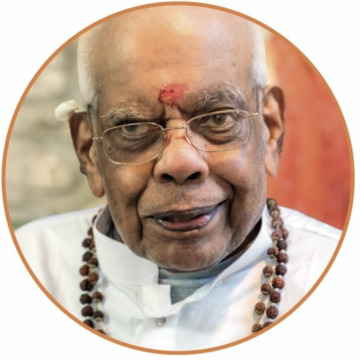
SwamiSATHYANANDASkanda Vale, Llanpumsaint 13 February 1939 - 23 January 2026
Swami Sathyananda believed that the surest way to God was through service - quiet, practical, and done without expectation. He grew up in Sri Lanka, the son of a man who ran a small village temple. As a boy, Swami loved helping there, keeping the space clean and cared for. That early instinct never left him. Long before he became a monk, service was already his way of life. He married and raised a family, establishing a home on land that others had dismissed as barren. With patience and steady work, he planted fruit trees and made it productive. He worked as a postmaster, cycling daily to his job, and in his spare time continued to tend the local temple. Even then, he found his deepest satisfaction not in position or recognition, but in usefulness. In 1997, Swami came to the UK. His intention was simple: to find a temple where he could volunteer full-time and give the rest of his life to seva. For several years he visited temples in and around London, searching for a place that felt right. Eventually, a friend mentioned Skanda Vale in rural West Wales and offered to take him there. Swami arrived at Skanda Vale in 2002, on a busy festival day, with little more than a suitcase and no ambition beyond service. As he later recalled, the moment he passed through the gate he felt something settle in his body - a sense that this might be the place. What struck him most was the absence of money talk. Everything was offered freely. Nothing was demanded. If you could give, you gave; if you could not, you were equally welcome. For Swami, this was decisive. For his first years he lived simply as a devotee, taking on whatever work was needed: cleaning toilets, emptying bins, clearing rubbish, chopping vegetables. He was grateful for work that suited his age and strength, and he did it thoroughly, often singing bhajans as he cleaned. He never saw any task as beneath him. On the contrary, these were the jobs he loved most. After a period of training as a novice, he was ordained directly as a Swami, taking the name Sathyananda - affectionately shortened by many to "Swami Sathya". He often said he had never expected this, and never sought it. If anything, he delayed ordination, later regretting that he had not joined earlier while Guru was still in full health. Even as a Swami, he remained unchanged in spirit: content to serve, unconcerned with status, quietly getting on with things. One story he liked to tell captured this spirit perfectly. Asked to clean the toilets one day, he found there were no toilet rolls left. When he asked where they were kept, he was simply told there were none - perhaps he should pray. The following day, a van arrived full of toilet rolls, delivered as a first offering from a factory owner who felt moved to bring them to the temple. For Swami, it was reassurance: do the work, trust, and what is needed will come. Each morning, before the 5am puja, Swami went to Durga's Island to pray and sing softly to Mother. These early hours were part of his daily rhythm - quiet, unobserved, and unannounced. Swami also spent many years at the Swiss temple, SomaSkanda Ashram, where he became its first resident Swami. It was a natural fit. He needed practical help with the everyday running of the place, which quietly gave others a way in. People found themselves helping him, then helping the temple. Through steady sincerity and ordinary kindness, he brought the community together and helped establish the life of the Ashram. He held a deep reverence for life in all its forms. Whether it was a tiny robin, the fox who would eat from his hand, the deer he prepared food for each day, or the trees and plants around him - he saw all life as an expression of the Lord. This care was natural rather than sentimental. He had grown up feeding birds, and he carried that attentiveness with him wherever he lived. Those who knew him remember his warmth and approachability. People simply enjoyed being around him - no need to make a conversation out of spirituality, or ask big questions. He had a dry, gentle sense of humour: a raised eyebrow, a well-timed pause, then that soft chuckle that made his shoulders bounce. He especially loved being around children and animals, and he loved music - it would often nudge him into a devotional mood, one he slipped into easily, as if it was never far away. Swami spent most of his days doing what he had always done: chopping vegetables, cleaning, preparing food for animals, tending the small, unseen needs that keep a community alive. He had no grand aspirations. As he once said, he did not wish to be a great saint - only to be a good Swami, and to serve for as long as he was able. In that, his life was remarkably consistent. His duties and his aspirations were one and the same. Swami Sathyananda will be missed. He embodied a slower, simpler way of living - steady, faithful, and without drama. His life was a reminder that devotion does not need to be loud, and that holiness can lie in doing what needed doing, day after day, and expecting nothing in return.
Just to serve.
Further enquiries to Mr Dorian Harries of G Harries & Sons, Funeral Directors, Maesybwlch, Pencader, Carmarthenshire, SA39 9BY. Tel: 01559 384903 / 384386
Keep me informed of updates